
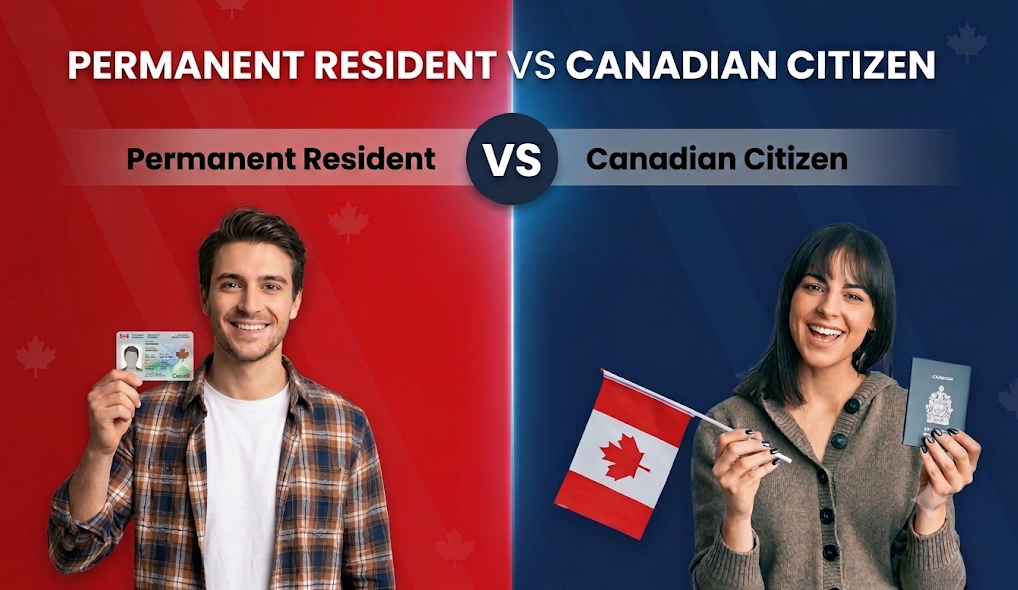
A permanent resident (PR) can live, work and study anywhere in Canada, use public healthcare and receive Charter protections, but cannot vote, run for office or hold a Canadian passport, and must meet a residency obligation to keep their status. A Canadian citizen has all of those rights and no residency requirement, and cannot lose citizenship for a later criminal conviction.
If you are settled in Oshawa, Durham Region or anywhere else in Canada, understanding permanent resident vs citizen Canada rules helps you protect your status and plan your next step. At Visarete, our Oshawa-based team explains these differences in plain language every week.
Permanent Resident vs Canadian Citizen: Quick Comparison Table
| Right or Rule | Permanent Resident | Canadian Citizen |
| Live and work in Canada | Yes, almost any job | Yes, any job |
| Public healthcare and education | Yes, with provincial rules | Yes |
| Vote in elections | No | Yes |
| Run for public office | No | Yes |
| Canadian passport | No (holds a foreign passport) | Yes |
| Residency obligation | 730 days in every 5 years | None |
| Status can expire or be lost | PR card renews every 5 years; status can be lost | Citizenship does not expire |
| Can be removed for serious crime | Yes | No |
| Sponsor family | Yes, while living in Canada | Yes, including some cases from abroad |
| Dual citizenship | Not applicable | Allowed |
| Jobs needing citizenship or high clearance | Often restricted | Eligible |
Details can change. Always confirm current rules on the IRCC website.
What Rights Does a Permanent Resident Have in Canada?
A PR is someone granted permanent residence but not citizenship. Day to day, your life looks very similar to a citizen’s.
PR Card Rights in Canada
Your PR card rights Canada include the freedom to:
- Live, work and study anywhere in Canada
- Access public healthcare, subject to your province’s rules
- Apply for most jobs without a work permit
- Receive protection under the Canadian Charter of Rights and Freedoms (with some exceptions, like voting)
- Apply for Canadian citizenship after meeting the requirements
You also have responsibilities: pay taxes, follow Canadian laws and meet the residency obligation.
The 730-Day Residency Obligation
Every PR must be physically present in Canada for at least 730 days in every five-year period. The days do not need to be continuous. Some time abroad can count in specific situations, such as accompanying a Canadian citizen spouse or working full-time for a Canadian business outside the country.
Falling short can put your status at risk, though you remain a PR until an official decision is made. If you are worried about your days, speak with a regulated consultant before you travel or renew your card.
Can a PR Vote in Canada?
No. Permanent residents cannot vote in federal or provincial elections, and cannot run for elected office. This is one of the clearest differences in the can PR vote Canada question. Only citizens can take part in federal, provincial and, in most cases, municipal elections.
PR Travel Restrictions: What You Need to Know
PR travel restrictions surprise many newcomers. As a PR, you can travel, but you must follow a few rules.
- You need a valid PR card or a Permanent Resident Travel Document (PRTD) to board a commercial flight, train, bus or boat back to Canada.
- You still need a valid passport from your country of citizenship, and possibly a visa for your destination.
- Your travel days matter. Long trips can eat into the 730 days you need to keep your status.
- PR cards expire after five years (sometimes less) and must be renewed. Renewal requires proof that you met the residency obligation. Our team can help with PR card renewal and travel document applications.
A citizen with a Canadian passport faces none of these issues and can live abroad for years without losing citizenship.
Can a PR Sponsor Family in Canada?
Yes. Many people ask can PR sponsor family, and the answer is yes, with conditions. A permanent resident living in Canada can generally sponsor a spouse, common-law or conjugal partner, and dependent children. They may also be able to sponsor parents and grandparents when the program is open, though intake is limited and often by invitation.
Citizens have extra flexibility. In some cases, a citizen can sponsor a spouse or child while living abroad if they plan to return to Canada. Learn more about the process in our spousal sponsorship guide. If your partner is already in Canada and needs to work while waiting, see our spouse open work permit service.
Citizenship Benefits Over PR
The main citizenship benefits over PR fall into three groups: security, mobility and participation.
1. Security and Permanence
A citizen cannot lose status for a later criminal conviction, does not need to renew a PR card and has no residency obligation. A PR who is found inadmissible, for example for serious criminality, can face removal.
2. Mobility and the Canadian Passport
A Canadian passport is widely accepted for visa-free or easier travel and gives you consular help abroad. You also have an unconditional right to enter and remain in Canada.
3. Political and Civic Participation
Citizens can vote, run for office, serve on juries and apply for jobs that require citizenship or top-level security clearance.
4. Family Benefits
Citizens can generally pass citizenship to children born abroad, subject to current rules. Citizenship laws have been updated recently, so confirm the latest on the IRCC site if this matters to you. Canada also allows dual citizenship, so in most cases you do not have to give up your original nationality.
How to Go From PR to Citizen
You can apply for citizenship when you meet these main requirements:
- Physical presence: at least 1,095 days in Canada in the five years before you apply
- Taxes: filed as required
- Language: English or French ability, typically proven for adult applicants within the required age range
- Knowledge test: a test on Canada’s history, values and institutions
- No prohibitions: such as certain criminal charges or immigration violations
After you apply, you will complete any test or interview and then attend an oath ceremony. Processing times vary, so check IRCC for current estimates. If you are building toward this goal, we can review your days, documents and eligibility through our citizenship application support.
Should You Apply for Citizenship or Stay a PR?
Most eligible PRs benefit from applying. But your situation may be different.
Consider applying soon if you:
- Travel often or want to live abroad for periods
- Want to vote and take part in civic life
- Have a criminal record concern in the future that could threaten PR status
- Want to simplify life by ending PR card renewals
Think carefully first if you:
- Come from a country that does not allow dual citizenship
- Are still short on physical presence days
- Have unresolved tax or immigration issues
A short profile review can clarify the right timing. Our free immigration assessment is a good place to begin.
Common Mistakes Permanent Residents Make
- Assuming a valid PR card equals guaranteed status. The card is a document, not the status itself.
- Not tracking days outside Canada. Keep exact travel records.
- Travelling with an expired PR card. You may be refused boarding.
- Applying for citizenship too early. Errors cause delays or refusals.
- Ignoring tax filing. It is a citizenship requirement and a basic duty for PRs.
Why Choose Visarete for PR and Citizenship Guidance
Your status is too important to leave to guesswork. Here is how Visarete helps clients in Oshawa and across Canada.
CICC-Regulated Immigration Consultants
You get advice from licensed professionals who are accountable for their work.
Local Oshawa Office With Nationwide Support
Meet us in person in Oshawa or online from Durham Region, the GTA or abroad.
Clear, Honest Advice
We tell you where you stand on residency days, travel risk and eligibility, even when the answer is not what you hoped for.
Complete Document Support
From PR card renewal to citizenship applications and sponsorship, our team handles forms, evidence and follow-up.
Transparent Fees
Clear retainer terms, no surprise charges.
Support at Every Stage
From your landing day to your citizenship oath, we are your long-term immigration partner.
Frequently Asked Questions: Permanent Resident vs Citizen Canada
1. What is the main difference between a permanent resident and a citizen in Canada?
Citizens can vote, run for office, hold a Canadian passport and live abroad without losing status. PRs cannot vote or hold a Canadian passport and must meet a 730-day residency obligation.
2. Can a permanent resident vote in Canada?
No. Only Canadian citizens can vote in federal and provincial elections.
3. Can a PR travel outside Canada?
Yes, but you need a valid PR card or PRTD to return by commercial carrier, plus your passport. Long trips can affect your residency obligation.
4. Can a PR sponsor family members?
Yes. PRs living in Canada can generally sponsor a spouse, partner and dependent children, and sometimes parents and grandparents when programs are open.
5. How long before I can apply for citizenship?
You need 1,095 days of physical presence in the five years before applying, along with the other requirements. Processing then takes additional time.
6. Can a PR lose their status?
Yes. Status can be lost by failing the residency obligation after a formal decision, serious inadmissibility, misrepresentation or a removal order. Citizens are not subject to these losses in the same way.
7. Does Canada allow dual citizenship?
Yes. Canada allows dual and multiple citizenship, but your other country’s laws may not.
Plan Your Next Step With Visarete
Whether you want to protect your PR status, renew your card or move toward citizenship, the right plan starts with a clear view of your situation. Book a free assessment with Visarete, your trusted immigration consultant in Oshawa, and get answers you can act on.

